

· By Dahlia Rizk
How Long Do Babies Use Car Seats? A Simple Guide by Stage
Quick Answer
Babies use car seats from their very first ride home and continue using car seats or boosters for years. The exact timeline depends on your child’s height, weight, age, maturity, and the limits of the specific car seat.
Most children move through these stages:
- Rear-facing infant car seat or rear-facing convertible car seat
- Forward-facing car seat with a harness
- Booster seat
- Vehicle seat belt
The safest approach is not to rush each transition. Keep your child in each stage until they reach the highest height or weight limit allowed by their car seat manufacturer.
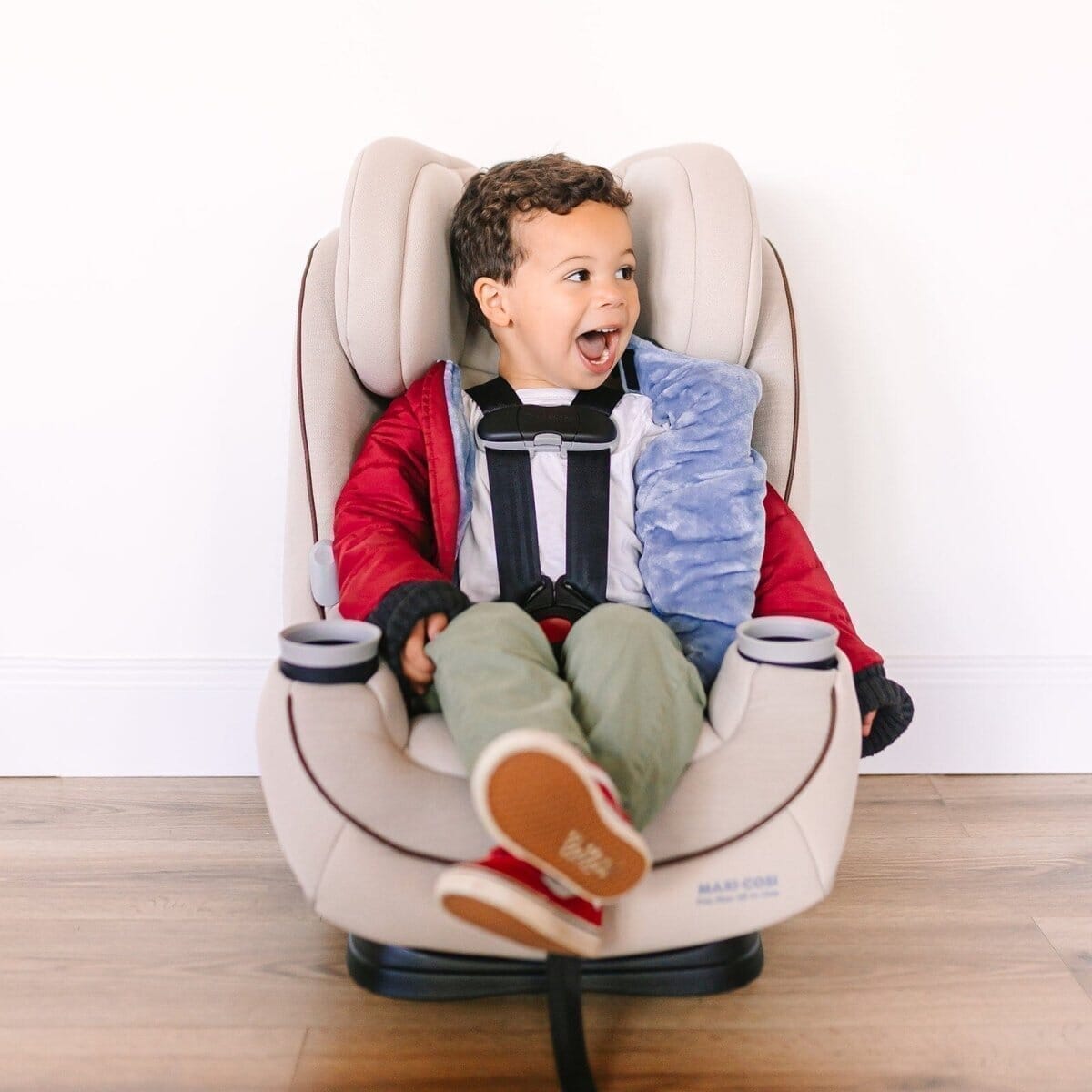
For cold-weather rides, Buckle Me Baby’s Car Seat Coats and Car Seat Blankies can help keep kids warm without adding unsafe bulk under the harness.
How Long Do Babies Need Car Seats?
Babies need car seats every time they ride in a vehicle. A car seat is not just for the newborn stage. It is part of child passenger safety for many years.
Your baby will start in a rear-facing car seat. As they grow, they will eventually move into a forward-facing car seat, then a booster seat, and finally the regular vehicle seat belt.
The timing depends less on age alone and more on:
- Your child’s height
- Your child’s weight
- Your child’s development
- Your child’s maturity
- The car seat’s height and weight limits
- The vehicle seat belt fit
A child should not move to the next stage just because they hit a certain birthday. They should move when they have outgrown the current stage and can use the next one correctly.
Stage 1: Rear-Facing Car Seat
Babies start in a rear-facing car seat. This may be an infant car seat, a convertible car seat, or an all-in-one car seat used in rear-facing mode.
Rear-facing is designed to support a baby’s head, neck, and spine. Babies and toddlers should stay rear-facing as long as possible, until they reach the highest height or weight limit allowed by the seat.
Rear-facing seats include:
- Infant car seats
- Rear-facing convertible car seats
- Rear-facing all-in-one car seats
Your baby should stay rear-facing until:
- They reach the rear-facing weight limit
- They reach the rear-facing height limit
- The manual says they no longer fit rear-facing
- Their head is too close to the top of the seat shell based on the manual
Some babies outgrow an infant car seat before they are ready to turn forward-facing. In that case, the next step is usually a rear-facing convertible car seat.
How Long Do Babies Use Infant Car Seats?
An infant car seat is usually used during the newborn and baby stage. These seats are rear-facing only and often have a carry handle and a base that stays installed in the vehicle.
Many babies use an infant car seat until they reach the seat’s height or weight limit. Some babies outgrow the infant seat by height before weight, especially if they have a longer torso.
A baby may be ready to move out of the infant car seat when:
- They exceed the infant seat’s weight limit
- They exceed the infant seat’s height limit
- Their head is too close to the top of the shell based on the manual
- The harness no longer fits correctly
- The seat manual says they have outgrown it
After the infant car seat, your baby should usually move into a rear-facing convertible car seat, not straight to forward-facing.
Stage 2: Rear-Facing Convertible Car Seat
A rear-facing convertible car seat is the next step for many babies after the infant carrier. Convertible seats usually stay installed in the car and can often be used rear-facing for a longer time.
Convertible car seats are helpful because they:
- Usually have higher rear-facing limits than infant seats
- Can fit older babies and toddlers
- Stay installed in the vehicle
- Later convert to forward-facing use
- Allow extended rear-facing within the seat limits
Your child should stay rear-facing in the convertible seat until they reach the rear-facing height or weight limit for that seat.
When Can Babies Face Forward?
Babies should not be turned forward-facing too early. The safer choice is to keep your child rear-facing as long as possible within the car seat’s limits.
Before turning your child forward-facing, check:
- Your child’s age
- Your child’s height
- Your child’s weight
- Your state’s law
- Your car seat manual
- Whether your child has outgrown rear-facing mode
Even if your child meets the minimum legal age in your state, that does not always mean it is the safest time to turn them around. The car seat’s rear-facing limits matter.
Stage 3: Forward-Facing Car Seat With Harness
Once your child has outgrown rear-facing mode, they usually move to a forward-facing car seat with a five-point harness.
A forward-facing harnessed seat helps restrain your child’s shoulders, hips, and body. Your child should stay in the forward-facing harness until they reach the seat’s height or weight limit.
Forward-facing seats may include:
- Convertible car seats in forward-facing mode
- Combination car seats
- All-in-one car seats in forward-facing mode
Your child may have outgrown the forward-facing harness when:
- They exceed the forward-facing weight limit
- They exceed the forward-facing height limit
- Their shoulders are above the highest allowed harness position
- Their ears are above the allowed seat shell or headrest position
- The manual says they no longer fit in harness mode
Do not move to a booster until your child is big enough and mature enough to sit correctly for the whole ride.
Stage 4: Booster Seat
After a child outgrows the forward-facing harness, the next step is usually a booster seat.
A booster seat does not use a five-point harness. Instead, it helps position the vehicle seat belt correctly across your child’s body.
A booster helps the seat belt fit so:
- The lap belt sits low across the hips
- The shoulder belt crosses the middle of the chest and shoulder
- The belt does not rest on the belly
- The shoulder belt does not sit against the neck
- The child can sit upright for the entire ride
Booster seats are important because adult seat belts are designed for adult bodies. Many children are not ready for the regular seat belt alone, even if they feel “too big” for a booster.
When Can a Child Stop Using a Booster Seat?
A child can stop using a booster seat when the vehicle seat belt fits correctly without it. This is often later than parents expect.
Use the seat belt fit test:
- Can your child sit with their back against the vehicle seat?
- Do their knees bend naturally at the edge of the seat?
- Does the lap belt sit low across the hips, not the belly?
- Does the shoulder belt cross the middle of the chest and shoulder?
- Can your child stay seated like this for the whole ride?
If the answer is no to any of these, your child still needs a booster seat.
How Long Do Kids Need to Sit in the Back Seat?
Children should ride in the back seat whenever possible until at least age 13. Even after a child is out of a booster seat, the back seat is usually the safer place.
The front seat has added risks because of airbags and crash impact zones. A child may technically fit the seat belt but still be safer riding in the back.
Why You Should Not Rush Car Seat Stages
It can feel exciting when your child reaches a new stage, but moving too soon can reduce protection.
Try not to rush from:
- Rear-facing to forward-facing
- Forward-facing harness to booster
- Booster to seat belt
- Back seat to front seat
Each stage is designed for a certain level of size, strength, and maturity. Keeping your child in the current stage until they outgrow it is usually safer than moving early.
Car Seat Use by Age: General Guide
Every child and every car seat is different, but this is a general way to think about the stages.
Newborns and babies
Usually use:
- Rear-facing infant car seat
- Rear-facing convertible car seat
Toddlers
Usually use:
- Rear-facing convertible car seat
- Forward-facing only after outgrowing rear-facing limits
Preschoolers
Usually use:
- Forward-facing car seat with harness
- Rear-facing if they still fit the rear-facing limits
School-age kids
Usually use:
- Forward-facing harness if they still fit
- Booster seat after outgrowing the harness
Older kids
Usually use:
- Booster seat until the seat belt fits correctly
- Back seat until at least age 13
Use this as a general guide, but always follow your child’s actual seat limits and your state law.
What About Car Seat Expiration?
Car seats do not last forever. Even if your child still fits the seat, the seat itself may expire.
Most car seats have an expiration date printed on the seat, base, label, or listed in the manual. Expiration dates vary by manufacturer and model.
Check the expiration date if:
- You are using a hand-me-down seat
- You are saving a seat for another baby
- You bought a used seat
- You cannot remember when the seat was purchased
- You are using an extra seat in a grandparent’s car
Do not use an expired car seat. If you cannot find the date, contact the manufacturer.
Can You Reuse a Car Seat for Another Baby?
You may be able to reuse a car seat for another baby if it is still safe to use.
Before reusing a car seat, confirm:
- It is not expired
- It has not been in a crash
- It has all original parts
- The labels are readable
- The manual is available
- The harness is not damaged
- There are no cracks in the shell
- It has no unresolved recalls
- You know the full history of the seat
If you are unsure, do not use it until you contact the manufacturer or a certified child passenger safety technician.
What Should Babies Wear in Car Seats?
Babies and children should wear thin, fitted layers in car seats. Avoid bulky coats, thick snowsuits, or puffy jackets under the harness.
Bulky clothing can make the harness seem tight when it is not actually snug against the child’s body. In a crash, that extra padding can compress and leave the harness too loose.
Better options include:
- Thin pajamas
- Fitted layers
- Lightweight fleece
- A car seat-safe coat
- A blanket over the harness
- A car seat blankie for infants
Buckle Me Baby’s Car Seat Blankies are helpful for babies in infant seats because they add warmth over the harness.
For older babies, toddlers, and kids, Car Seat Coats help keep children warm while still allowing a safer harness fit.
How to Know If Your Child Is Ready for the Next Seat
Before switching seats or stages, ask yourself:
- Has my child actually outgrown the current seat?
- Did I check both height and weight limits?
- Did I read the car seat manual?
- Does my child meet the next stage requirements?
- Can my child sit correctly in the next stage?
- Does the next seat fit my vehicle?
- Can I install or use it correctly every ride?
If you are unsure, wait and get help. There is usually no benefit to moving to the next stage early.
When to Get Help From a CPST
A certified child passenger safety technician, often called a CPST, can help you check your car seat installation, harness fit, and stage choice.
This can be especially helpful if:
- You are switching from infant seat to convertible seat
- You are thinking about turning forward-facing
- You are moving from harness to booster
- You are unsure if your child has outgrown a seat
- You have multiple car seats in one vehicle
- You drive a small car or truck
- You are using a hand-me-down seat
- You cannot get a tight installation
A CPST can help you make the safest choice for your actual child, seat, and vehicle.
Car Seat Stage Checklist
Use this simple checklist before moving your child to the next stage:
- Check the car seat manual
- Check height limits
- Check weight limits
- Check harness position
- Check head clearance rules
- Check state law
- Check vehicle fit
- Check installation
- Check whether your child can use the next stage correctly
- Get help if anything is unclear
FAQs About How Long Babies Use Car Seats
How long do babies use infant car seats?
Babies use infant car seats until they reach the seat’s height or weight limit, or until the manual says they no longer fit. Many babies then move to a rear-facing convertible car seat.
When do babies stop using rear-facing car seats?
Babies and toddlers should stay rear-facing until they reach the highest height or weight limit allowed by their rear-facing car seat.
When can babies face forward in the car?
A child can face forward after they outgrow the rear-facing limits of their car seat and meet the legal requirements in your state. Safer practice is to rear-face as long as possible within the seat limits.
How long do kids use forward-facing car seats?
Kids use forward-facing harnessed car seats until they reach the seat’s forward-facing height or weight limit, or until the manual says they have outgrown the harness.
When can a child stop using a booster seat?
A child can stop using a booster when the vehicle seat belt fits correctly without it. The lap belt should sit low on the hips, the shoulder belt should cross the chest, and the child should be able to sit correctly for the whole ride.
Do kids need to sit in the back seat?
Yes, children should ride in the back seat whenever possible until at least age 13.
Final Thoughts
Babies use car seats from their first ride home and continue using car seats or boosters for many years. The safest timeline is based on your child’s size, stage, maturity, and the limits of the specific seat.
Do not rush the transitions. Keep your child rear-facing as long as possible, use the forward-facing harness until it is outgrown, use a booster until the seat belt fits, and keep children in the back seat whenever possible until at least age 13.
For safer, cozier rides through every stage, Buckle Me Baby has practical options that help keep kids warm without unsafe bulk under the harness:
Share:
Shop clothes that makes your life easier


Let customers speak for us
Anonymous
Great!
Great!
Buckle Me Baby

Anonymous
Perfect
Perfect for cold Alaska winters!
Car Seat Blankies

Zofia
Cute colours and the jammies really work, no mess
Cute colours and the jammies really work, no mess in the car seat!
Blowout Blockerz Bamboo Jams
Anonymous
great
great idea
Car Seat Blankies
Karen E.
Love everything about it including the price and
Love everything about it including the price and quick delivery
Car Seat Blankies

Krystin
I love this car seat blanket! It is so warm
I love this car seat blanket! It is so warm and soft. My granddaughter enjoys wearing it on cold mornings in the car. Definitely very happy with this purchase!
Clearance 2025 Cozier Car Seat Blankie

Laura H.
I don't usually write reviews
But this is our 3rd winter with one of these coats, and they're a lifesaver. Slight learning curve when you first get one, but not having to take the coat on and off in the cold is worth it. It's also piece of mind that it won't fall off when driving or if in an accident (kiddo will be warm when waiting for first responders). We live in Chicago and the Toast is warm enough for quick errands and the Toasty is nicer for deep winter. We do have a larger parka coat if we spend more time outdoors.
Clearance Buckle Me Baby Car Seat Coat
Jama L.
Amazing!
This is absolutely amazing.. kept our granddaughter toasty warm on a cold night kicking off the Christmas holiday in Tennessee!
Clearance 2025 Cozier Car Seat Blankie

Esther G.
Great quality, great service
Shipping was super fast and the snowsuit feels like quality! I love the warm cuffs on the neck and sleeves. I got moonwalker so it can be gender nautral for future kids but it can pass as purple with certain lighting.
Infant Car Seat Snowsuits
Anonymous
Better than expected
I had the lightest version which was nice for all year, but with colder days coming I ordered this version and its better than expected. Definitely thick but not too heavy, well-made and baby loves it!
Clearance 2025 Cozier Car Seat Blankie

Aisha S.
Best pjs EVER!
I have tried bamboo pajamas from SO many different brands, but none are as good as the BMBC pjs. They're actually buttery soft, hold up extremely well in the wash, and my baby can wear them for so long due to the extendable arms/legs and stretchy material. My 14 month old is 95th percentile for height and weight and the 6/9 month BMBC pjs still fit him!!! Cannot recommend this company enough. And Dahlia, the owner, is so sweet and responsive.
Clearance Bamboo Jams

JoAnn H.
Adoreable
So cute and so soft
Wild Child Bamboo Jams

Amy a.M.P.
So cozy and warm!
This is so easy to use in the car and instantly warm.
Clearance Kids 2025 Coziest Car Seat Blankie
debi B.
Car seat blanket
great product! So soft and cozy bought for my 6 month old grandson. Had to roll the sleeves up a bit but it will fit him. Next winter too ! Would recommend !
Clearance Kids 2025 Coziest Car Seat Blankie
Gigi
“These are perfect”, says my granddaughter who has 12 month old twins. They are safe in their seatbelts and stay covered and warm. The Velcro in the back is great. She says to give these blankies a 5 star rating.
Clearance Kids 2025 Coziest Car Seat Blankie